Injection Mold Transfer Services
Injection Mold Transfer Services for Troubled Production Programs
Move the Mold. Solve the Problem.
When an injection molding program is struggling, transferring the tool is only the beginning. PlastiCert evaluates the mold, process, material and part requirements to identify what is preventing consistent production—and what should happen next.
We receive customer-owned molds built by other suppliers, including molds built overseas, and help customers move troubled or uncertain programs toward stable production.
Contact our Engineering Team to discuss your problems and see how we may be able to help.
Why programs come to PlastiCert
- Recurring defects or inconsistent parts
- Missed deliveries or supplier risk
- Undocumented or overseas-built tooling
- Repeated repairs without root-cause resolution
- Complex materials, inserts or added operations
- Reshoring, re-sourcing or supply diversification
ISO 9001:2015 Certified
In-house mold design, build, maintenance and repair
Injection molding presses from 55 to 500 tons
What is an injection mold transfer?
An injection mold transfer moves a customer-owned mold and its production program from one injection molder to another. A successful transfer often includes much more than transportation. The mold may need documentation review, incoming inspection, disassembly, controlled sampling, repair, process development, dimensional validation and a carefully planned production transition.
Every transfer is different. A mold with complete records and a stable production history presents a different challenge than an undocumented tool that has accumulated years of wear and repeated repairs. We start by understanding what you have, what is going wrong and what the finished part needs to do.
Why customers transfer injection molds
Quality variation, scrap, delivery problems, supplier changes, reshoring plans and the need for stronger engineering support can all trigger a transfer. Installing the mold in another press may show whether it runs, but it does not necessarily explain why dimensions drift, parts stick, defects repeat or the process remains unstable.
A mold transfer should solve the underlying problem—not move it to a different production floor.
A Four-Phase Approach
PlastiCert’s Mold Transfer Process
The scope is built around the mold, part requirements, production history, available documentation and the condition of the existing process.
PHASE 1
Understand the Program
Initial review: We begin with a direct conversation about the reason for the transfer. What is going wrong? Is the immediate concern quality, capacity, delivery, tooling condition, communication or supply continuity?
Technical intake: Available part files, part drawings, order quantities, approved samples, quality records, mold information and files, and prior process information help establish the starting point.
PHASE 2
Evaluate the Mold and Process
Inspection and sampling: The mold’s condition and compatibility are evaluated. When needed, it is opened, examined and sampled under controlled conditions to help separate tooling issues from process, material or part-design concerns. The team observes how the mold fills, cools and repeats.
Root-cause analysis: A mold review verifies whether the design and quality are appropriate for the project requirements. Flow analysis verifies whether the requested part geometry can be produced using the selected material.
PHASE 3
Build and Execute the Corrective Plan
Condition and repair plan: When corrective work is needed, PlastiCert documents the observed condition, recommended repairs or modifications and the reasoning behind the recommendations.
Customer review and in-house work: The customer reviews and authorizes the scope before PlastiCert’s toolmakers complete approved repairs or modifications alongside processing and production personnel.
PHASE 4
Prove the Process and Support Production
Resampling and dimensional validation: After approved work is completed, the mold is resampled and the results are compared with the applicable part and quality requirements.
Production approval: Before formal production approval, the customer defines the part-quality requirements and required documentation, such as first-article inspection, a process capability study, PPAP or part testing.
What PlastiCert Evaluates
A transferred-mold evaluation is tailored to the reason for the move and the evidence available. Depending on the program, our team may review:
- Visible wear, damage, corrosion or prior repairs
- Mold cleanliness and maintenance condition
- Cooling circuits and water-line condition
- Ejector components and part-release concerns
- Slides, lifters, undercuts and other moving features
- Gates, runners, vents and evidence of filling problems
- Mold and press compatibility
- Available drawings, files, process sheets and maintenance records
- Material-handling requirements
- Approved samples and dimensional requirements
- The relationship among tooling condition, process settings and observed defects
Tooling and Molding Under One Roof
A mold-transfer problem often crosses the boundary between tooling and processing. PlastiCert’s in-house tool shop designs and builds new molds and maintains, repairs and modifies existing molds. That reduces handoffs and allows toolmakers to work directly with engineering, sampling and production personnel.
Depending on the findings, approved work may include restoring maintenance condition, repairing cooling circuits, replacing worn components, correcting ejection or modifying mold features. Some tools require limited preparation; others need significant corrective work before reliable production can be expected.
Mold Transfer Case Study
From Band-Aid Repairs to Stable Production
The Problem
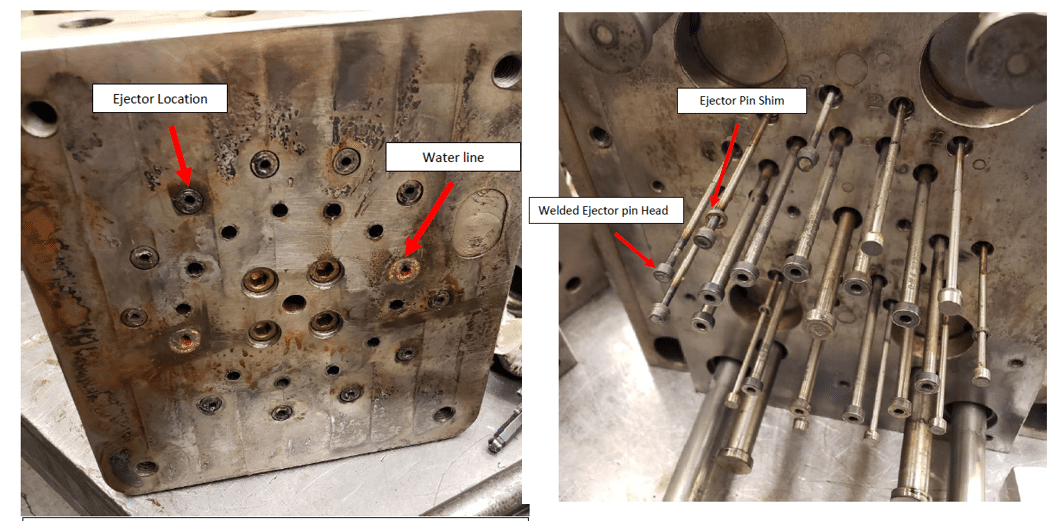
A customer came to PlastiCert because its existing supplier could not meet quality and lead-time requirements. The mold had been built overseas, documentation was limited and sample parts were inconsistent. The tool contained layers of previous changes that addressed symptoms instead of the underlying issues.
The PlastiCert Approach
PlastiCert brought the mold in-house for inspection, disassembly and controlled sampling before committing to a corrective plan. The team documented the tool’s condition, identified underlying issues and prepared a formal Mold Condition & Repair Plan.
The approved work addressed maintenance condition, cooling and water lines, ejection and other mold features. PlastiCert’s in-house toolmakers completed the repairs while working directly with processing personnel.
The Outcome
After the corrective work, the mold stabilized, the parts met the applicable requirements and production was approved. The program developed into a long-term customer relationship.
Is Your Program a Fit for PlastiCert?
PlastiCert is generally a strong fit when:
- The current molding process is difficult or inconsistent.
- The program requires more technical involvement than the current supplier provides.
- The mold needs evaluation, maintenance, repair or modification.
- The part uses a complex engineered material.
- The component includes inserts or value-added operations.
- Quality, reliability and engineering collaboration matter more than obtaining the lowest possible piece price.
We may not be the right fit for extremely high-volume commodity molding where the purchasing decision is driven almost entirely by the lowest unit cost and dedicated automation. Our best work happens when a customer needs a capable manufacturing partner willing to understand the program and help solve the difficult parts.
See the industries PlastiCert serves and hear from our customers.
Frequently Asked Questions About Mold Transfers
Can PlastiCert receive a mold from another injection molder?
Yes. PlastiCert receives and runs customer-owned molds built by other suppliers, including molds built overseas.
Does every transferred mold need repair?
No. The amount of work depends on the mold’s condition, compatibility, production history and part requirements. The evaluation determines what is actually needed.
What information should we provide before transferring a mold?
Useful starting information includes a 3D part file, drawing, estimated quantities, approved samples, known quality concerns, mold information and any available maintenance or process history.
Can PlastiCert help if our current molder cannot hold tolerance?
PlastiCert can evaluate the mold, process and material to help identify likely causes. Whether the existing mold can meet the required tolerance cannot be determined until the program and tooling are reviewed.
Does PlastiCert have an in-house tool shop?
Yes. PlastiCert designs and builds molds and maintains, repairs and modifies existing tooling. This allows toolmakers to work directly with the people responsible for sampling and production.
Can PlastiCert support complex materials and insert-molded parts?
Yes. PlastiCert molds standard and high-temperature thermoplastics and routinely performs insert molding. The material, insert design, tooling and production requirements are reviewed as part of the transfer.
How can we reduce supply disruption during a mold transfer?
Begin planning before the current supply is exhausted. Gather available part, mold, resin, process and quality records; identify inventory coverage; define approval requirements; and allow time for incoming inspection, material lead time, sampling, repair and validation.
Related PlastiCert Capabilities
A mold transfer may uncover tooling, part-definition or process issues that require additional technical support. Explore reverse engineering for molded parts and tooling, injection mold design and in-house tooling, injection molding DFM support and reshoring injection molding.
Bring Us the Mold—and the Problem Behind It.
If your current molder is struggling, your tooling has an uncertain history or you need to qualify another injection molding source, send us what you have. We will review the situation with you and determine whether PlastiCert may be a fit.
Contact our Engineering Team to discuss your problems and see how we may be able to help.